
At ScaleFlux, we design storage that doesn’t just keep up with modern data demands, it anticipates them. During a recent live demo on SC25 show floor, our team walked through the capabilities of the CSD5000 series, showing exactly how our latest drives perform under real workload pressure. The results speak for themselves: sustained throughput, consistent latency, and intelligent data reduction that amplifies performance/watt to save system-level power.
Here’s a breakdown of what we showcased.
- Setting the Stage: What We’re Testing
- Write Performance: Turning Compressibility Into Power Savings
- Read Performance: Efficiency That Scales With Workload
- Mixed Workloads: Real Efficiency for Real Applications
- Data Reduction: The Heart of Performance-Per-Watt Gains
- Final Thoughts: A Drive Built for Today’s Power-Constrained World
Setting the Stage: What We’re Testing
In the demo, we connected a CSD5000 drive and launched a series of tests to assess power consumption and performance/watt under read-intensive, write-intensive, and mixed read-write workloads. Then came the benchmarks. And that’s where things got fun.
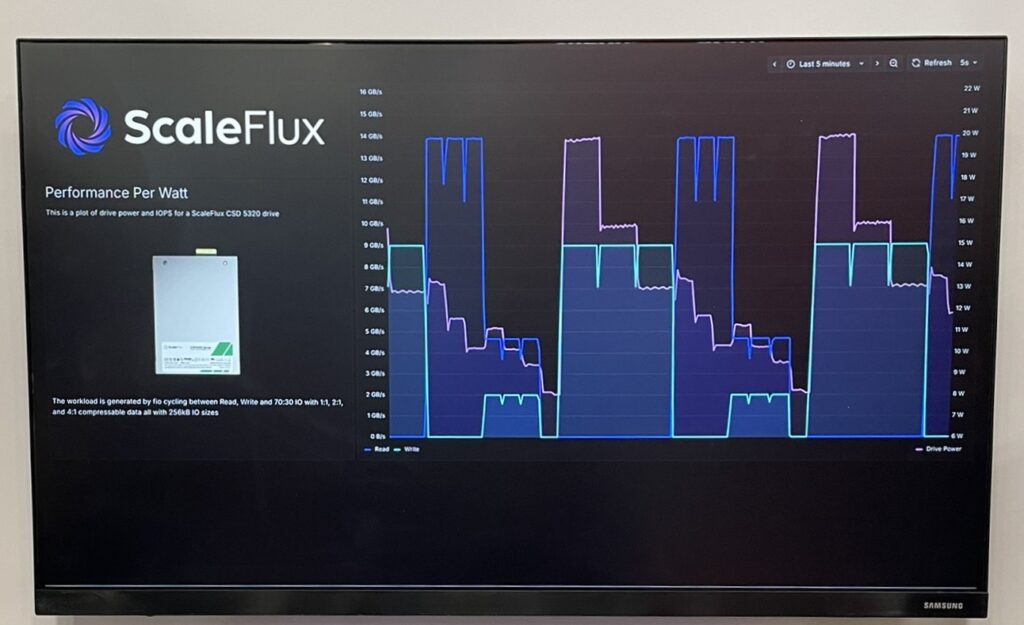
Write Performance: Turning Compressibility Into Power Savings
We kicked things off with sequential writes, but instead of focusing on max throughput, the real story emerged in the power readings. As soon as the write test began, the CSD5000 started compressing the incoming data on the fly. This reduced the amount of physical data written to the NAND, which directly lowered drive activity and, in turn, kept power consumption nearly flat.
The watt meter showed activity, yet the effective write throughput, after accounting for compression, rose rapidly and stabilized. The drive wasn’t working hard; it was working more efficiently.
This is why the CSD5000 is ideal for:
- Log ingestion with repetitive patterns
- High-volume sensor data with natural redundancy
- Real-time analytics pipelines where compressibility is common
When your data is compressible, the CSD5000 delivers more throughput per watt than a standard SSD, even before you scale the system.
Read Performance: Efficiency That Scales With Workload
Next, we switched to sequential reads. While the system monitor maintained the read pipeline reporting familiar high numbers, the power data told the more important story: the host’s power consumption barely moved.
Because the CSD5000 writes less data physically to the back-end media (thanks to earlier compression), it has less work to do when retrieving that data. The result? Higher effective read rates for the same watt of power consumed, and more consistent performance because there’s less strain on the drive’s internal pathways.
In AI training, financial modeling, and large-scale ETL, where datasets are massive, the advantage is clear: You move more usable data without increasing your power budget.
Mixed Workloads: Real Efficiency for Real Applications
Most systems juggle reads and writes simultaneously, so we ran a mixed workload to emulate real-world application behavior. Instead of looking for peak performance, we focused on efficiency and stability under load.
Here’s what stood out:
- No performance cliffs, because compressible data reduces write amplification
- Lower power draw, even as workload intensity increased
- More predictable latency, since the drive handles fewer physical operations
- No need for overprovisioning, because efficiency is built into the hardware
The CSD5000 consistently delivered more useful work per watt, exactly what production systems need when power and cooling budgets are tight.
Data Reduction: The Heart of Performance-Per-Watt Gains
The demo highlighted one of the CSD5000’s fundamental advantages: hardware-accelerated data reduction.
With every compressible block of data:
- Fewer bytes are physically written to back end media
- Less power is consumed at the drive and system level
- Less heat is produced (reducing cooling requirements)
- Endurance improves naturally
- Effective throughput rises without increasing wattage
This is what sets ScaleFlux apart:
- More performance per watt
- More endurance per dollar
- More capacity without more drives
In data centers where power is capped, and increasingly expensive, these compounding gains matter.
| Workload | Compressibility | Throughput [GB/s] | Power [W] |
| Sequential Write | 1:1 | 9 (Limited by workload) | 11.25 |
| Sequential Write | 2:1 | 9 (Limited by workload) | 10.25 |
| Sequential Write | 4:1 | 9 (Limited by workload) | 9.5 |
| Sequential Read | 1:1 | 12 (Limited by workload) | 13.25 |
| Sequential Read | 2:1 | 12 (Limited by workload) | 11.5 |
| Sequential Read | 4:1 | 12 (Limited by workload) | 10.25 |
| Random 70Rd:30Wr | 1:1 | 4.5 (Limited by workload) | 11.25 |
| Random 70Rd:30Wr | 2:1 | 4.5 (Limited by workload) | 10.5 |
| Random 70Rd:30Wr | 4:1 | 4.5 (Limited by workload) | 9.5 |
Final Thoughts: A Drive Built for Today’s Power-Constrained World
This demo wasn’t about chasing big headline numbers. It was about showing—live and transparently, how the CSD5000 delivers exceptional performance per watt by automatically exploiting data compressibility.
The real highlights?
- Higher effective throughput without higher power
- Lower write amplification = longer drive life with predictable latency
- Lower energy use = Lower lifetime TCO
- Consistent mixed-workload efficiency
- Hardware-accelerated data reduction that multiplies performance per watt
Whether you’re building AI pipelines, high-performance databases, or real-time analytics systems, the CSD5000 helps you do more with the same power budget. Traditional SSDs simply can’t match this efficiency profile.
Curious to see the full demo yourself? Watch it here, live from the show floor.